How to Use a Camera to Deepen Intimacy (Without It Being Weird)

There's a moment in a lot of long-term relationships where intimacy starts to feel like something you do rather than something you inhabit. The motions are familiar. The outcome is predictable. The presence — the quality of actually being there, curious and alive and genuinely encountering your partner — has gotten quieter over time without either of you quite noticing when it happened.
Couples reach for novelty when this happens, which makes sense. Novelty activates the same neurological pathways as early-stage desire — the dopamine response, the heightened attention, the sense of your partner as someone you're genuinely discovering rather than someone you already know. The challenge is finding novelty that serves the relationship rather than just distracting from it.
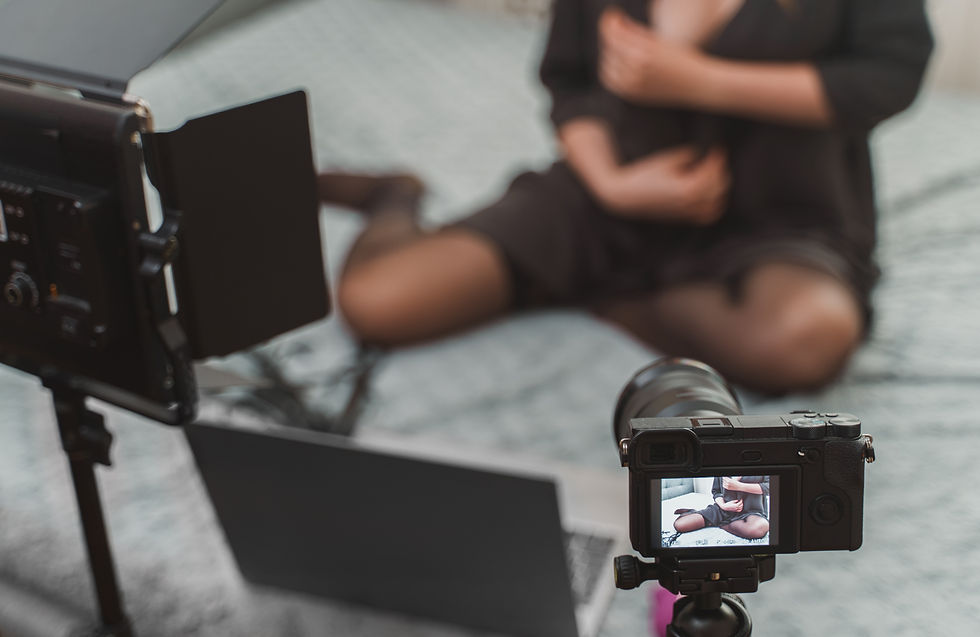
A camera — phone, dedicated device, whatever you have — is one of the most underused and misunderstood tools available to couples who want to bring more aliveness into their intimate lives. Not because recording yourselves is inherently erotic (though it can be), but because the camera changes the quality of attention in a room in ways that are worth understanding.
Here's how to actually use it well.
Why the Camera Changes Everything
Before getting into the specific applications, it's worth understanding what a camera actually does to the intimate dynamic — because this is the part most guides skip.
A camera introduces a new perspective into the room. Your partner's perspective, specifically, but externalized — made visible in a way that your ordinary experience of intimacy doesn't provide. When you know you're being seen, or when you're watching yourself being seen, something shifts in how you inhabit your own body. The spectatoring that usually keeps you slightly outside your own experience — monitoring yourself from the observer's position — gets redirected. Instead of watching yourself anxiously, you start performing for each other. And performance, in the right context, is not a bad thing. It's presence with an audience, and that audience is the person you love.
The camera also slows things down. When there's a lens in the room, both partners tend to become more deliberate — more aware of what they're doing, how they're moving, what they're communicating. That deliberateness is actually a form of presence. It's attention, brought to bear on the experience rather than drifting elsewhere.
Used thoughtfully, the camera doesn't take you out of intimacy. It gives you a new way in.
Using the Camera as an Erotic Tool — Performing for Each Other
This is the most immediately playful application, and the one with the lowest barrier to entry because it doesn't require recording anything at all.
The concept is simple: one partner has the camera (or phone), and the other performs for it. Not in a pornographic sense — in the sense of being seen, being attended to, being the deliberate subject of their partner's gaze. The person holding the camera isn't a passive observer; they're directing, appreciating, responding. The dynamic creates a quality of focused erotic attention that ordinary intimacy doesn't always produce.
What this does practically is give both partners a role. The person being filmed gets to be seen — fully, deliberately, by someone who finds them desirable — which is an experience that many people in long-term relationships haven't had in years. The person behind the camera gets to look without the usual pressure to simultaneously perform. Both experiences tend to be more activating than they expect.
A few ways to explore this without it feeling awkward:
Start clothed. Have one partner film the other in a slow, appreciative way — face, neck, hands, movement. The point isn't nudity; it's the quality of attention. Getting comfortable being genuinely looked at is its own practice, and it often surfaces more emotion than people expect.
Let the person behind the camera direct. Simple instructions — "turn toward me," "slower," "look at me" — give the performer something to respond to and keep the energy active rather than stalling into self-consciousness.
Switch. The partner who directed gets to be seen. The partner who was seen gets to look. Both sides of the dynamic are worth experiencing.
Filming Yourselves for Private Playback
This is where most couples either lean in with enthusiasm or stop reading entirely. If you're in the second group, stay with it for a moment, because the case for this application isn't primarily about the footage — it's about what the act of filming does to the experience itself.
When couples film themselves with the intention of watching the footage privately, the immediate effect is heightened presence. Both people are more deliberate, more attuned to each other, more in their bodies and less in their heads. The camera creates a kind of witnessing that activates attention in a way that unobserved intimacy doesn't always reach.
The footage, if you watch it, does something different: it gives you access to your partner's experience in a way you never have during sex itself. You see what they look like when they're genuinely lost in pleasure. You see how they look at you. You see things about your own intimacy — its rhythms, its quality, what's actually present in the room — that are invisible from the inside. Many couples describe watching their own footage as genuinely surprising, and the surprise is almost always positive: is that what we actually look like together?
The consent and security conversation is non-negotiable. Before filming anything, both partners need to be explicitly enthusiastic — not just willing, but actually wanting this. A "fine if you want to" is not sufficient. The conversation needs to cover: where the footage will be stored (locally only, never cloud-synced), who has access, what happens to it if the relationship ends, and how either partner can call for it to be deleted at any time without explanation required. This conversation isn't a formality. It's the foundation of the trust that makes the experience valuable rather than anxiety-producing.
On the security side: use a dedicated folder with a strong password, turn off automatic cloud backup before filming, and review your phone's backup settings explicitly. The footage should live exactly where you decide it lives, nowhere else.
Once those foundations are in place, the practical setup is simple. Fixed phone position or small tripod. Soft, warm lighting (the single biggest variable in how footage feels to watch back). Framing that captures both partners rather than one. And then — this is the important part — put the phone down and be inside the experience rather than directing it.
Using a Mirror to Build Presence and Body Awareness
This is the most underrated application, and the one most directly connected to the somatic work that underpins everything Coelle is built on.
Mirrors in the intimate space do something specific: they return you to your own body. When you can see yourself — not performing for anyone, not being evaluated, just visible to yourself — a different quality of awareness becomes available. You notice your own expression. You notice how you move. You notice what genuine arousal and genuine presence actually look like from the outside, which turns out to be important information for the relationship between how you feel and how present you're able to be.
For many people, particularly men with histories of body shame or performance anxiety, seeing themselves during intimacy initially activates the worst kind of self-monitoring — the critical evaluative gaze that makes everything worse. This is real, and worth acknowledging. The practice isn't to force yourself into comfort you don't have. It's to gently extend tolerance for being seen, including by yourself, over time.
Start with less vulnerability: a mirror that's at a distance, or angled so you catch glimpses rather than a full view. Notice what you feel. Practice staying with it rather than looking away. The goal isn't to become a narcissist who watches himself during sex — it's to develop enough familiarity with your own visible body that being seen stops triggering the self-consciousness that pulls you out of presence.
For couples who use mirrors together, the added dimension is watching your partner experience pleasure. This is one of the most intimate things available in an intimate relationship, and it's one that the ordinary geometry of sex — face to face, or not — doesn't always provide. Seeing your partner's face in a mirror during a moment of genuine pleasure is different from seeing it directly. It has a quality of witnessing that direct encounter doesn't quite capture.
A Note on Comfort and Pacing
None of this works if one partner is significantly less comfortable than the other and is going along rather than genuinely participating. The value of all three of these applications depends on both people being actually present and actually willing — not performing willingness to please their partner while internally managing discomfort.
The right pace is the pace of the less comfortable partner, always. Not as a concession but as a practical matter: genuine presence can't be rushed into existence. If your partner wants to try the mirror but not filming, start there and stay there until the mirror feels genuinely okay before introducing anything else. If performing for the camera sounds interesting but watching back doesn't, explore the first without committing to the second.
What you're building, with all of these practices, is a shared erotic vocabulary — a set of experiences you've had together that belong to your relationship specifically, that have expanded what's available between you, and that you carry forward as a kind of intimate history that deepens the encounter every time.
The camera is just a tool. What it's pointed at is the connection between you. Keep that the center of the frame.
Coelle's guided sessions are designed to create exactly this kind of deliberate, present, inhabited intimacy — with structure that makes the quality of encounter accessible rather than something you have to manufacture on your own. Explore sessions here.


