The Toilet Paper Roll Test: What Reddit's Most Popular Girth Benchmark Actually Tells You
- Scott Schwertly

- Jul 23
- 4 min read
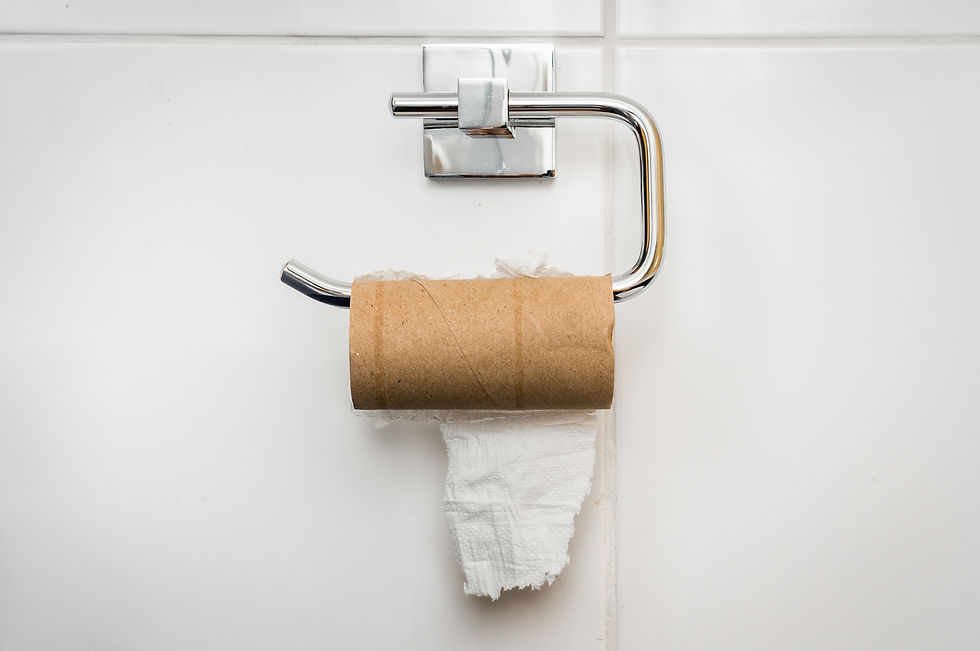
If you've spent any time in men's health or relationship communities on Reddit, you've encountered the toilet paper roll test. The premise is simple: a standard toilet paper cardboard tube has an inner diameter of approximately 1.6 inches which works out to a circumference of roughly 5 inches. The claim circulating in communities like r/bigdickproblems and r/marriedsex is that a man who can't fit his erect penis through the tube has above-average girth.
It's one of the more persistent informal benchmarks in men's anatomy discourse, it gets referenced constantly, and it's worth examining with both honesty and some precision because there's a real data point embedded in the folklore, alongside some limitations worth naming.
What the Cardboard Tube Actually Measures
The inner circumference of a standard toilet paper roll is approximately 5 to 5.25 inches, depending on the brand. This is a meaningful measurement because it sits very close to population average penile girth — the 2015 BJUI systematic review of 15,521 men found the average erect circumference to be approximately 4.59 inches.
So the basic arithmetic of the test checks out. A man whose erect girth is 5 inches or more — above average, though not dramatically so — would find a toilet paper tube a tight fit or wouldn't fit through it at all. The test is a rough proxy for "somewhat above average in girth," which is approximately accurate given the numbers involved.
The limitations are worth naming:
Erect girth varies significantly with arousal level. Maximum erect circumference requires full arousal, which a solo bathroom test doesn't reliably produce. Many men who would pass the test under optimal conditions might not at 80% arousal, and vice versa.
Toilet paper tube dimensions vary. The inner diameter isn't standardized across all brands. Some tubes are noticeably wider than others, which shifts the benchmark by a meaningful margin.
The test measures girth at one location. Penile girth isn't uniform along the shaft — it varies from base to mid-shaft to glans. Depending on where along the shaft the measurement is taken, the result differs.
None of this invalidates the test as a rough benchmark — it genuinely is centered near average — but it's worth knowing that it's an informal estimate, not a medical measurement.
What Above-Average Girth Actually Means
Setting aside the cardboard tube, the data on penile girth is worth knowing clearly.
The BJUI systematic review, which remains the most rigorous available dataset on penile dimensions, found:
Average erect circumference: 4.59 inches (11.66 cm)
The range considered within normal: roughly 3.5 to 5.7 inches at the 5th and 95th percentiles
A circumference of 5 inches places a man in approximately the 65th percentile. Not exceptionally rare, but meaningfully above average — the toilet paper test is benchmarking something real.
A circumference of 5.5 inches puts a man in approximately the 85th percentile. At 6 inches, the 95th percentile. These are the ranges where "significantly above average" starts to apply in any statistically meaningful sense.
What Women Actually Prefer (Revisited)
As I wrote in the girth post on this blog, the 2015 PLOS ONE study using 3D-printed models found that women preferred an erect circumference of approximately 4.8 to 5.0 inches for long-term partners. This sits right at — or just above — the toilet paper tube benchmark.
Which means the test is identifying something that is both above population average and at or near the center of expressed female preference. The men who "pass" the toilet paper test are landing in the range that the most rigorous research on female preference identifies as most desired for long-term partnerships.
This is worth sitting with: the benchmark is roughly calibrated to what the research shows women prefer, which is a moderately above-average circumference rather than an exceptionally large one. The folklore, in this case, is pointing at something real.
The Shame and Comparison Trap
What the toilet paper test can't escape — regardless of how accurate the measurement is — is the psychological function it's serving for most men who engage with it.
Men who are confident in their anatomy don't typically need cardboard tube validation. The test gets attention and participation because girth anxiety is widespread and the informal benchmark offers either reassurance or a focal point for the anxiety. Both outcomes — relief at passing, or increased concern at not — are measuring a psychological state as much as a physical dimension.
As I've written in the penis size and girth posts: the anxiety men carry about their anatomy is almost universally disproportionate to what their partners actually experience and report. 85% of women in large surveys report satisfaction with their partner's size. The gap between that number and the ambient girth anxiety most men carry is enormous — and the gap lives in male peer culture and pornography rather than in actual partnered experience.
The toilet paper test is accurate enough as a rough anatomical benchmark. What it can't tell you is what your specific partner experiences, what produces pleasure in her specific body, or how much the quality of your presence and attention matters relative to your circumference.
The answer to the last question, if you've read anything else on this blog, you already know.
The Only Test That Actually Matters
Here's the honest summary: the toilet paper roll test is a reasonable informal proxy for "somewhat above population average in girth," and the number it's calibrated to sits near the center of expressed female preference in research. As casual anatomy benchmarks go, it's grounded in something real.
What it can't measure is whether the anxiety driving you to take it is serving you. Whether your intimate life is what you want it to be. Whether the attention and presence you bring to encounters with your partner is producing the connection both of you are looking for.
Those are the variables that determine satisfaction. The cardboard tube can't help with any of them.
Ready to go deeper?
If this resonates, there are two ways to take the next step with Coelle.
Download the Coelle app — Guided audio intimacy sessions designed for couples who are ready to stop performing and start arriving. Presence matters more than any measurement. Download Coelle here.
Work with me directly — I offer one-on-one sex and intimacy coaching for individuals and couples, drawing on my background in sport psychology and years of personal somatic work. Body confidence and anatomy anxiety are regular topics in my coaching work. Learn more about coaching here.


Comments